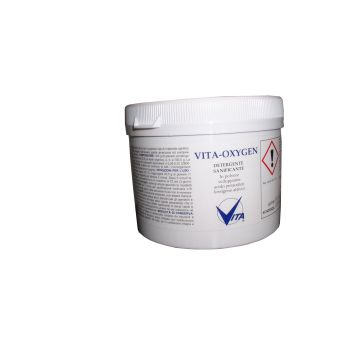
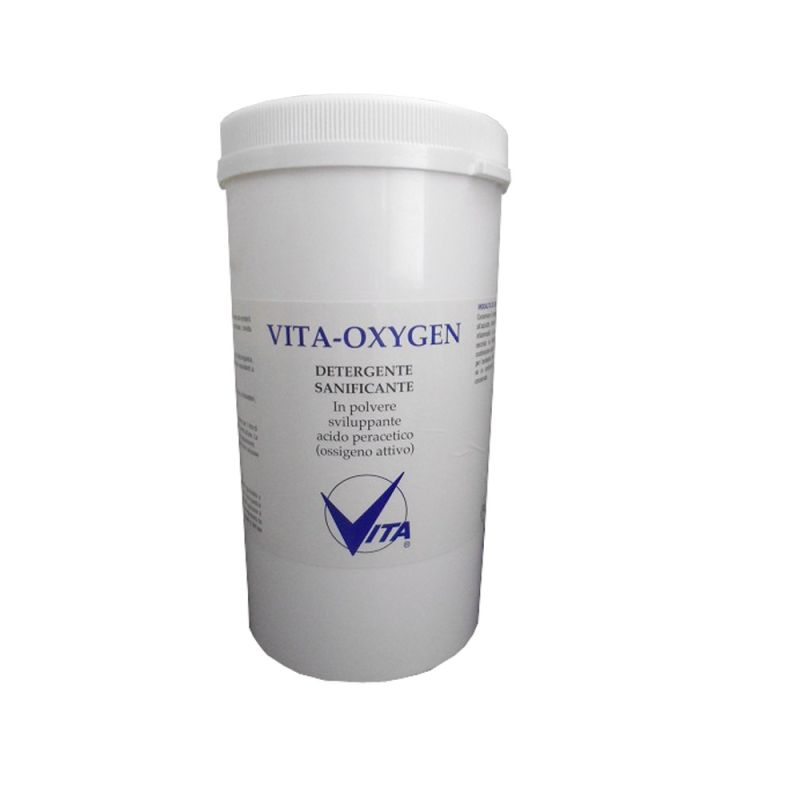








VITA-OXYGEN sanitizing detergent - Conf. 1 kg - FOR beekeeping
VITA-OXYGEN powdered sanitizing detergent developing peracetic acid (active oxygen) Store the product tightly closed, cool and 'dry , away from riducent and flammable materials For disinfection from all Beehive pathogens (American and European foulbrood, nosema ceranae, calcified brood, varroasis-related viruses ) of Beehives, combs and any type of beekeeping material.Vita Oxygen is a powerful, broad-spectrum sporicidal disinfectant based on the newest generation of pera-cetic acid, also used in hospital and medical settings for sterilization. Characteristics* broad-spectrum disinfectant: sporigenic and nonsporigenic bacteria, fungi and viruses) * remarkable rapidity of disinfection: contact time 30 minutes * non-corrosive on materials Method of usePreparation: dissolve Vita Oxygenin lukewarm water ( 20-30° )at doses of 10 grams per liter for decontamination/disinfection or 20 grams per liter for high-level disinfection. Shake for 2 / 3 minutes until much of the powder has dissolved. Wait the indicated activation time (15 minutes at 10 grams per liter and 30 minutes at 20 grams per liter ) following the label directions . Coarse manual cleaning is recommended to remove wax bridges or substantial propolis formations. Leave in contact with the solution 30 minutes or more. For disinfection of Beehives,frame timbers or other material, prepare suitable contain -tor and fill with solution. Allow the material to soak. Alternatively, spray with disinfet -tant and brush. For disinfecting honeycombs - Dip the honeycombs in the disinfectant solution letting the alveoli fill.Leave them in contact with the disinfectant then drain them by whisking them to empty the alveoli. Alternatively, the disinfectant can be sprayed with nebulizer directly on the combs.With the solution in nebulizer, thoroughly spray the combs or material. Manual application: can also be used to wash with brush and solution. Important Use concentrations and residence times in disinfection that are proportional to the amount of organic matter present to be removed.Disinfection time should be understood to be 30 minutes in cases where wax and propolis are present in superficial layers ( from a few thousandths of a milli-meter to half a millimeter ) such as may be the typical condition of Beehive walls or frame crossbars or uprights or the surface of a pocket feeder ,etc....No rinsing is required as the degradation products turn out to be water, oxygen and acetic acid. The dilute is not hazardous to the operator. The dilute is effective at its maximum potential for a time of 24 hours. Thereafter the sterilization action decreases.
VITA-OXYGEN powder sanitizing detergent developing peracetic acid (active oxygen) Store the product tightly closed, cool and 'dry , away from riducent and flammable materials For disinfection from all Beehive pathogens (American and European foulbrood, nosema ceranae, calcified brood, varroasis-related viruses ) of Beehives, combs and any type of beekeeping material. Characteristics* broad-spectrum disinfectant: sporigenic and nonsporigenic bacteria, fungi and viruses) * remarkable rapidity of disinfection: contact time 30 minutes * non-corrosive on materials Method of usePreparation: dissolve Vita Oxygenin lukewarm water ( 20-30°) at doses of 10 grams per liter for decontamination/disinfection or 20 grams per liter for high-level disinfection. Shake for 2 / 3 minutes until much of the powder has dissolved. Wait the indicated activation time (15 minutes at 10 grams per liter and 30 minutes at 20 grams per liter ) following the label directions . Coarse manual cleaning is recommended to remove wax bridges or substantial propolis formations. Leave in contact with the solution 30 minutes or more. For disinfection of Beehives,frame timbers or other material, prepare suitable contain -tor and fill with solution. Allow the material to soak. Alternatively, spray with disinfet -tant and brush. For disinfecting honeycombs - Dip the honeycombs in the disinfectant solution letting the alveoli fill.Leave them in contact with the disinfectant then drain them by whisking them to empty the alveoli. Alternatively, the disinfectant can be sprayed with nebulizer directly on the combs.With the solution in nebulizer, thoroughly spray the combs or material. Manual application: can also be used to wash with brush and solution. Important Use concentrations and residence times in disinfection that are proportional to the amount of organic matter present to be removed.Disinfection time should be understood to be 30 minutes in cases where wax and propolis are present in superficial layers ( from a few thousandths of a milli-meter to half a millimeter ) such as may be the typical condition of Beehive walls or frame crossbars or uprights or the surface of a pocket feeder ,etc....No rinsing is required as the degradation products turn out to be water, oxygen and acetic acid. The dilute is not hazardous to the operator. The dilute is effective at its maximum potential for a time of 24 hours. Thereafter the sterilization action decreases.
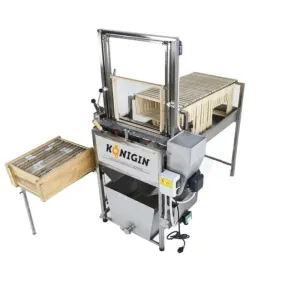
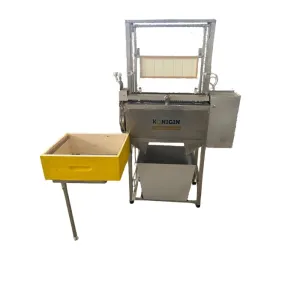
With this machine complete in every part, it will be possible to speed up uncapping and use the Extractor effectively. The output of the machine, is a minimum of 150 frames per hour, but you can get up to 250 frames per hour. Uncapping is carried out by knives placed parallel to the two sides of the frames, simultaneously on both sides.Due to the special structure of the blades, the cells are not damaged and therefore no deposits are formed on the blades.It does not require any kind of heating. The adjustment of the blades to the various frame sizes is done quickly, with a simple movement. The blades do not touch the slats of the frames but do not move within them, so no damage is generated on either the blades or the frames. The distance between the blades can also be easily adjusted during operation with the foot pedal or hand lever. The cut wax falls into a collection container equipped with a filter, and from here the honey then drips into the lower part of the container. It is also equipped with a convenient Honey super stand. It is available with 12 V or 230 V motor.
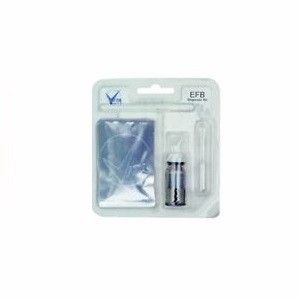
Instructions for use Extraction: Use the supplied spatula to extract three whole larvae showing suspicious symptoms. Unscrew the lid of the extraction bottle. Deposit the larvae into the bottle, again using the spatula. Shake vigorously so that the larvae soak into the buffer solution. CAUTION - The bottle contains buffer solution and sodium azide; not to be used for human use. Carefully screw the lid back on and shake vigorously for about 20 seconds so that the larvae mix well with the buffer solution. Performing the test: Remove a test device from the aluminum package. WARNING Do not touch the viewing window. Unscrew the lid of the bottle and with the dropper provided, take a good amount of solute. For best results, draw out the solute immediately after shaking so as to prevent bacteria from settling out of the suspension. Hold the device horizontally and gently drop 2-3 drops into the 'well provided. Hold the device horizontally until the extract is absorbed (about 30 seconds) and blue coloration appears in the display window. Wait until the control line (indicated by the letter C) appears and read the result (about 1-3 minutes). Take care to dispose of the test in an environmentally friendly manner. At low temperatures, the test takes longer; the ideal temperature for the test is 18°C and above. Interpretation of resultsAfter 3 minutes, the control line should be clearly visible in the display window of the device. A positive result (indicated by the appearance of both the test line and the control line-see below) indicates that the pathogen sought is present in the sample, and that the larvae taken has been infected with American foulbrood. Note that even a faint T-line indicates a positive result.A negative result (only appearance of the control line, test line absent) indicates that the sample does not have American foulbrood pathogens. A negative test result does not guarantee the absence of AFB infection in some other part of the colony than the sample tested. Choose the sample with the utmost care.
VITA-OXYGEN sanitizing detergent - Conf. 1 kg - FOR beekeeping