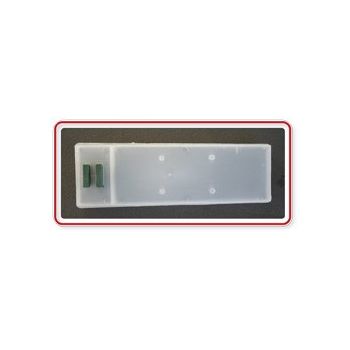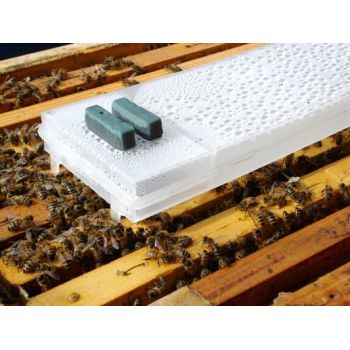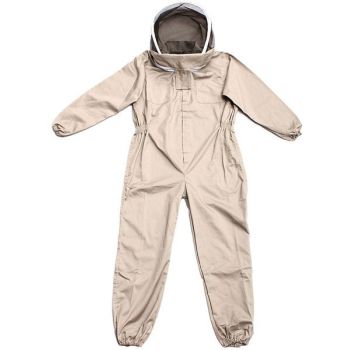
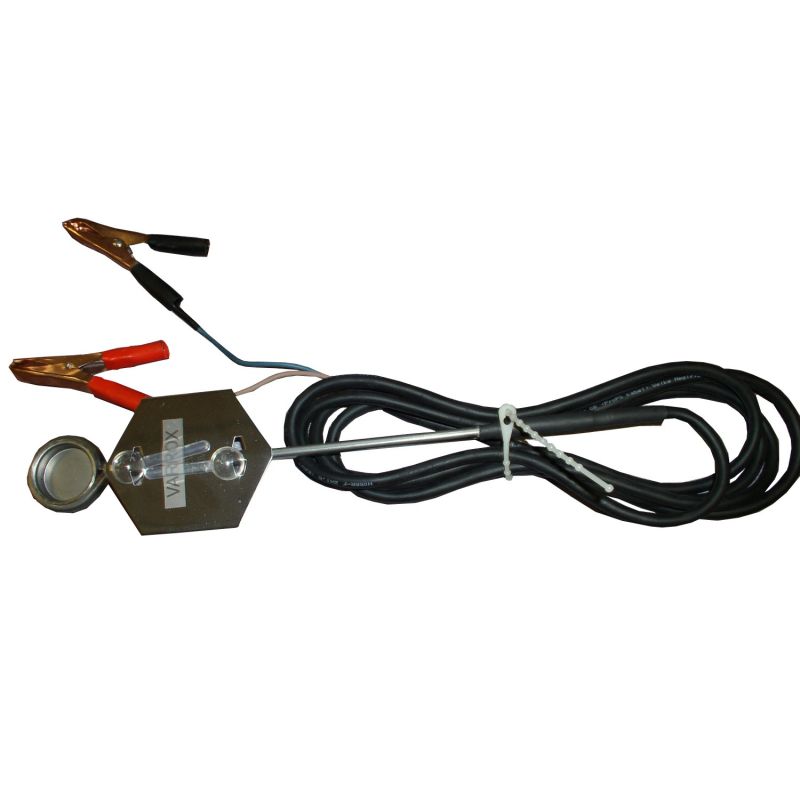








Method of carrying out the treatment 1) Clean the central frames of wax and propolis residues, where the evaporator will be placed.2) Put the Beehive "on bubble". 3) The "BioLetalVarroa formic" evaporator dispenses a minimum amount of formic acid (continuous release), sufficient to gradually break down nascent varroa, and not; therefore, it is recommended to make a treatment with sublimated oxalic acid (BioLetalVarroa sublimator recommended), to break down the maximum amount of varroa out of brood and continue, 3-4 days later, with the treatment by "BioLetalVarroa formic".4) Fill the dispenser with the amount needed for a single 25-day treatment, which is about 360 g of 85% formic acid, through the two holes provided to house the sponges, positioning it vertically and then closing it by means of the two caps provided by package until it is placed in the Beehive.5) If checking for Varroa drop, it is recommended not to clean the Varroa tray with a brush, but to operate it with a dustpan or possibly wear a protective mask, to avoid inhaling any residual oxalic acid.6) Place the dispenser on top of the frames in the center of the family, removing the end caps and inserting the two sponges into the holes provided, lodging them vertically until they touch the bottom.7) Close the Beehive with the upside-down cover if fitted with a 55mm frame. Otherwise, add a frame of the same size and close the Beehive normally8) To operate in excellent condition, it is necessary to protect the Beehive with insulation (polystyrene s20-25mm recommended) to prevent sun-induced overheating, thus allowing the evaporator to operate exclusively with the natural temperature of the bee family. 9) For the treatment of the cores, the execution of the treatment is equivalent to that of the Beehives. However, it is recommended to close one of the two holes with the cap, thus inserting only an evaporation sponge in the second hole.10) If climatic conditions induce excessive overheating, which cannot be reduced with the insulator, it is recommended to shorten the height of the sponges, checking that the daily evaporation does not exceed 14-18 g.11) When the treatment is finished, the container can be emptied of the residual acid, which can be reused for other treatments.
Guaranteed safety for consumers, bees, and Beehive products;Exact dosage for precise number of hives;Allowed in organic beekeeping;Easily soluble in sugar syrup at room temperature;Excellent efficacy (>96%) and tolerability;
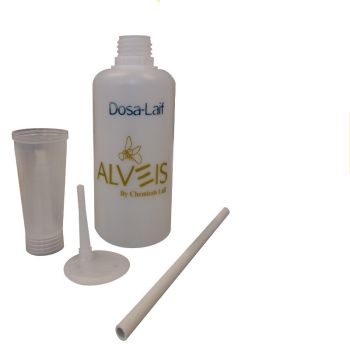
Dosa-Laif is the dispenser created to quickly and easily measure and administer solutions such as Api-Bioxal, ApiHerb, SuperBee, ApiGo and Micostop and will make you forget the classic syringe. - 100% MADE IN ITALY; - softer, wider bottle to ensure greater stability and easier pressure; - wider exit holes that allow dosing of even denser solutions such as ApiHerb and Superbee; - one-piece cap with spout.
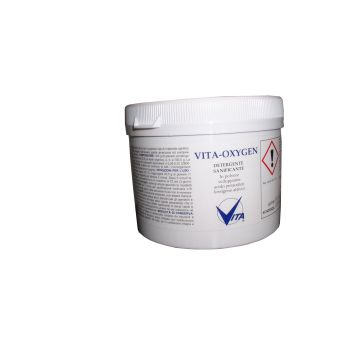
VITA-OXYGEN powder sanitizing detergent developing peracetic acid (active oxygen) Store the product tightly closed, cool and 'dry , away from riducent and flammable materials For disinfection from all Beehive pathogens (American and European foulbrood, nosema ceranae, calcified brood, varroasis-related viruses ) of Beehives, combs and any type of beekeeping material. Characteristics* broad-spectrum disinfectant: sporigenic and nonsporigenic bacteria, fungi and viruses) * remarkable rapidity of disinfection: contact time 30 minutes * non-corrosive on materials Method of usePreparation: dissolve Vita Oxygenin lukewarm water ( 20-30°) at doses of 10 grams per liter for decontamination/disinfection or 20 grams per liter for high-level disinfection. Shake for 2 / 3 minutes until much of the powder has dissolved. Wait the indicated activation time (15 minutes at 10 grams per liter and 30 minutes at 20 grams per liter ) following the label directions . Coarse manual cleaning is recommended to remove wax bridges or substantial propolis formations. Leave in contact with the solution 30 minutes or more. For disinfection of Beehives,frame timbers or other material, prepare suitable contain -tor and fill with solution. Allow the material to soak. Alternatively, spray with disinfet -tant and brush. For disinfecting honeycombs - Dip the honeycombs in the disinfectant solution letting the alveoli fill.Leave them in contact with the disinfectant then drain them by whisking them to empty the alveoli. Alternatively, the disinfectant can be sprayed with nebulizer directly on the combs.With the solution in nebulizer, thoroughly spray the combs or material. Manual application: can also be used to wash with brush and solution. Important Use concentrations and residence times in disinfection that are proportional to the amount of organic matter present to be removed.Disinfection time should be understood to be 30 minutes in cases where wax and propolis are present in superficial layers ( from a few thousandths of a milli-meter to half a millimeter ) such as may be the typical condition of Beehive walls or frame crossbars or uprights or the surface of a pocket feeder ,etc....No rinsing is required as the degradation products turn out to be water, oxygen and acetic acid. The dilute is not hazardous to the operator. The dilute is effective at its maximum potential for a time of 24 hours. Thereafter the sterilization action decreases.
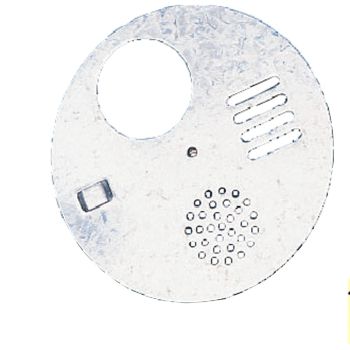
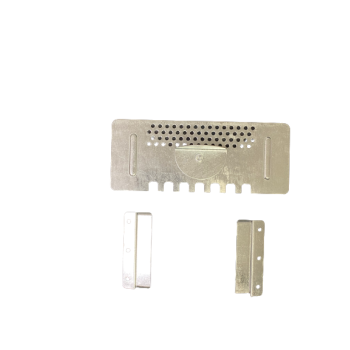
TOOTHED AND PERFORATED LITERATURE SHUTTER DOOR complete with handle and guides for Beehive D. B. 6 frames - length = 150mm