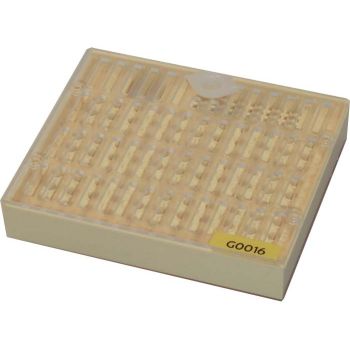











Patented system. Made of food-grade plastic material. PRINCIPLE OF OPERATION: With the use of our system, the queen lays directly in the dome. It allows rearing from the larvae of 6/24 hours. Dimensions of the cupolarve: 147 X 130 X 28 mm The cupolarve consists of 3 main pieces: ? 1 honeycomb body consisting of 110 honeycombs and 1 candy reservoir for queen introduction. The 110 alveoli receive 110 plastic domes (not supplied) or, alternatively, 110 wax domes (not supplied) ? 1 queen excluder grid ? 1 transparent plate RECOMMENDATIONS FOR USE: Cut a rectangle from a brood honeycomb in the center of the frame (against the wooden top) of the size corresponding to the cupolarve. Attach the cupolarve with two wood screws through the two corresponding holes. Place it to familiarize inside the family (in the middle of the brood) without the queen excluder grid. Smelling the queen and building wax bridges will facilitate the laying of the next brood. Feed the queen four days before , until the queen is introduced. Extraction of the dome should be done when the larva inside is 6/24 hours old (extraction with the "queen game" piece (HY G-0009) is recommended) If the rearing conditions are met (SEASON-TEMPERATURE-NUTRIENTATION- CUPOLARGE WELL IN THE CENTER OF THE COVADE etc...)everything should be fine. It is possible to dip the cupolarve in molten wax (in this case, do not exceed 65°) prior to placement in the family.
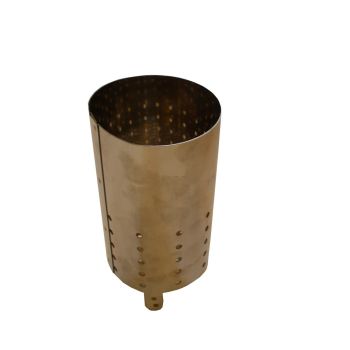
Cylindrical stainless steel container for smokers with diameter 10cm, essential for using pellet fuels
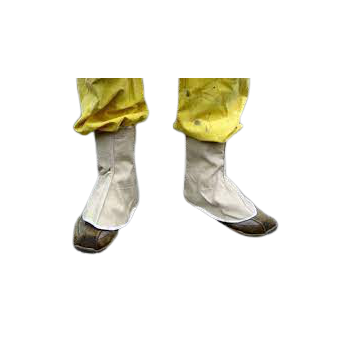
The elastic inner seal tightly wraps around the ankle so that bees cannot climb up the leg, and safety is assured.
It can be worn over any type of footwear, prevents sweating, unlike a boot, and can be put on and taken off with a simple gesture thanks to the side tear.
The linen gaiter can be machine washed at cotton temperature.